

The Language-Learning Flywheel: Why Consistency Gets Easier Over Time
When I think about a flywheel, I think about doing something difficult over and over until, eventually, it starts to feel easier.
At first, the wheel barely moves. It takes a disproportionate amount of effort to get it turning. But once it starts moving, maintaining that motion becomes easier. Eventually, you can pull harder, spin it faster, and build momentum on top of the work you've already done.
I think language learning works much the same way.
Learning a language can feel like a long slog punctuated by plateaus, backslides, doubt, and occasional breakthroughs. You can put in consistent effort for weeks, feel yourself improving, and then spend the next month wondering whether you've made any progress at all. Sometimes it feels like all that effort is merely preventing you from going backward.
I've experienced that cycle with two languages.
I studied French in middle school, high school, and college, only to drop it after school and rarely think about it again for nearly 20 years.
Italian came later. In my late 20s, I worked through Duolingo and a few grammar books for several months before traveling to Italy to visit family in 2016. After that, my Italian mostly consisted of periodic Duolingo streaks that never produced much meaningful progress.
I learned vocabulary. I became familiar with basic grammar and word order. But I couldn't do much with the language.
Ironically, some of my most useful learning happened during a week in Italy when I had to actually use it. I tried to communicate something, failed, tried again, and eventually managed to get my point across to a native speaker.
It wasn't elegant, but it was real.
Starting the Wheel Again
Several months ago, something changed.
My case for recognition of Italian citizenship was decided in my favor by an Italian court. Suddenly, Italian wasn't simply a language connected to my ancestry or an interesting thing to study. I had a much stronger reason to learn it properly.
Around the same time, I picked up Le Petit Prince and started reading French again.
Something unexpected happened.
French began cascading back.
Words and structures I hadn't consciously used in nearly two decades started resurfacing. Within a few weeks, I occasionally caught myself forming thoughts in French. The language wasn't gone. It had apparently been sitting somewhere in the back of my brain waiting to be used again.
So I decided to do something ambitious: study French and Italian simultaneously, with the goal of eventually reaching at least C1 in both.
The Common European Framework of Reference for Languages, or CEFR, divides language proficiency into six broad levels:
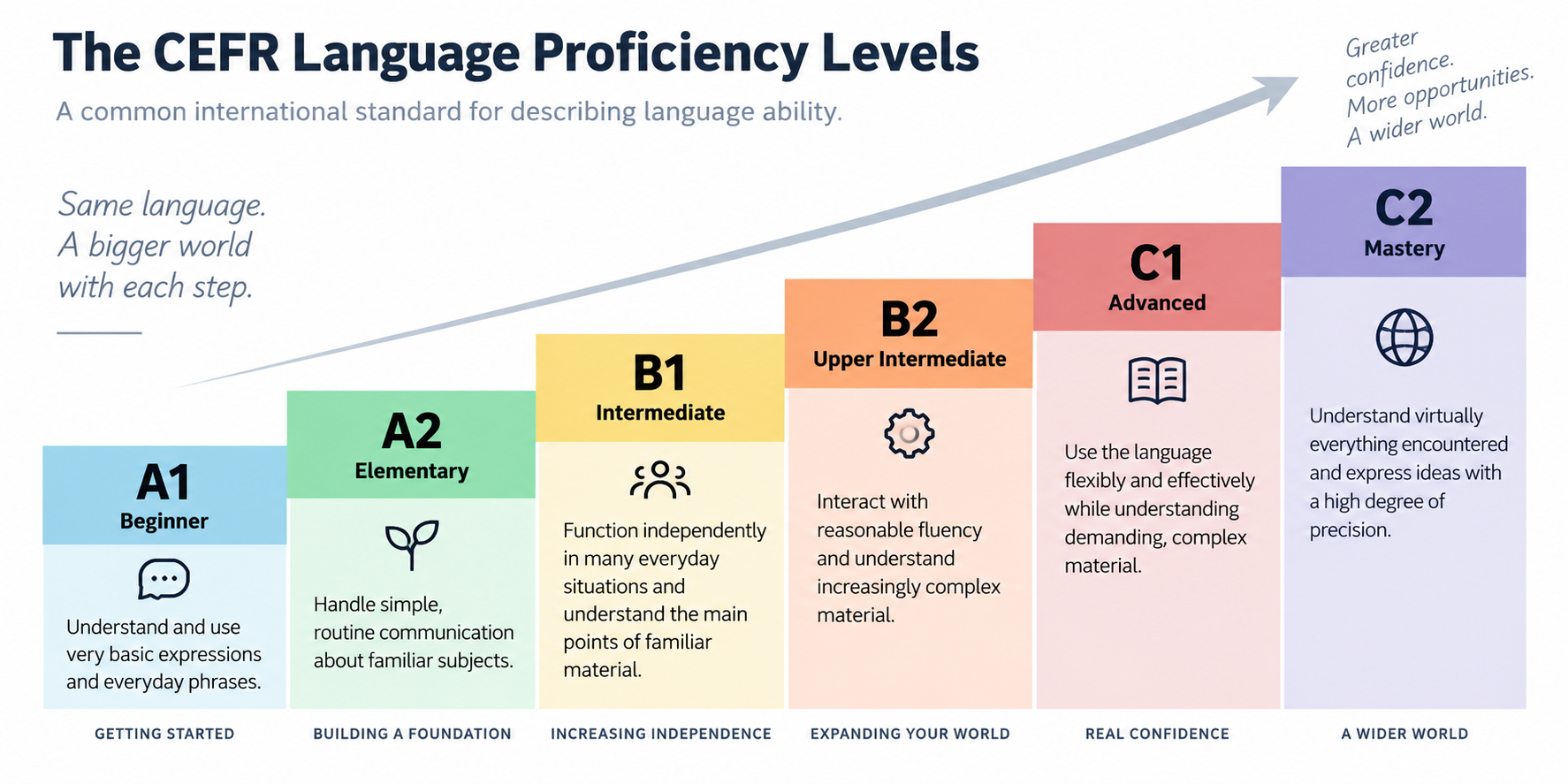
C1 is a long way from completing a language-learning app.
That's part of what makes the experiment interesting.
Measuring the Flywheel
There's another problem.
I'm a systems thinker.
Simply studying and trusting that I was getting better wasn't going to satisfy my brain. I wanted to know what I was doing, how much I was doing, and whether the accumulated work could tell me anything about where I might be headed.
So I started logging it.
Eventually, that evolved into an experimental XP system. Different language-learning activities receive different values based on the type and amount of work involved. Listening to an audiobook isn't necessarily equivalent to studying vocabulary, reading a difficult book, completing a structured lesson, or having a conversation with a native speaker.
I'm still refining those weights.
In fact, I don't yet know whether the system works.
That's important.
I'm not starting The Flywheel Linguist with a proven formula for language acquisition. I'm starting with a hypothesis and collecting the data necessary to find out whether I'm right.
So far, the XP totals seem to correspond reasonably well with descriptions of what learners at different CEFR levels should be capable of doing. But as my French and Italian improve, I expect to find weaknesses in the system.
That's useful information too.
The Flywheel in Practice
The interesting part is that tracking all of this has become almost effortless.
Logging my activities takes a few minutes each day. The rest of the time is spent actually learning.
The flywheel is moving.
My job is to keep it moving.
That doesn't mean every day feels productive. Some days I understand considerably more than I expected. Other days I struggle with something I thought I already knew.
But when I stop evaluating progress by the day and start looking at weeks and months, the trajectory becomes much easier to see.
I'm getting better.
More importantly, one form of learning begins supporting another.
Vocabulary makes reading easier. Reading exposes me to vocabulary and grammar in context. Listening makes familiar words easier to recognize at natural speed. Increased comprehension makes television and movies more enjoyable. That makes it easier to spend more time with the language. More time creates more comprehension.
The wheel turns again.
And as comprehension increases, activities that once required significant concentration become easier to incorporate into normal life.
That's where I think the flywheel becomes particularly powerful.
Language Learning in a Busy Life
I'm not doing this as a full-time language student
I work full time. I'm a father to a seven-year-old and a four-month-old. I have businesses and other projects I'm building. There are plenty of evenings when sitting down for an hour of intensive grammar study is simply not realistic.
So I've had to fit language learning into the life I actually have rather than the life an ideal language-learning schedule would require.
My commute is often filled with Pimsleur lessons or audiobooks. At home, I watch television and movies in French or Italian without English subtitles. When I have more mental energy, I read. Occasionally I'll work through an Anki vocabulary deck.
The intensity changes according to the day, but the wheel keeps turning.
For each of the last couple of months, I've managed to accumulate roughly 45 hours of total language exposure and study, divided between French and Italian.
That's not immersion.
But 45 hours a month becomes more than 500 hours a year if it can be sustained.
And sustainability may ultimately matter more than designing the theoretically perfect study schedule.
The Experiment
I don't have a perfect language-learning system.
That's precisely why I'm documenting this.
I'm running an experiment.
Can someone measure his way toward CEFR proficiency through consistent effort and a flywheel mindset?
Can an XP system be refined enough to provide a useful estimate of language ability before taking a formal assessment?
Can that system account for different goals? In my case, for example, reading literature matters more to me than achieving perfectly balanced abilities across reading, listening, speaking, and writing.
What happens when a man pushing 40, with a career, businesses, two young children, and limited free time, tries to learn two languages simultaneously?
Can he reach C1?
Can the process be replicated?
And what will several years of data ultimately tell us about how language learning actually happens?
I don't know yet.
But the flywheel is turning.